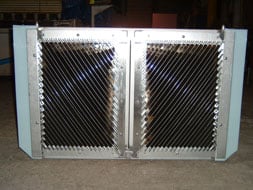
Flat Plate Herring Bone Design (55 degree angle)
Excerpt From A Presentation
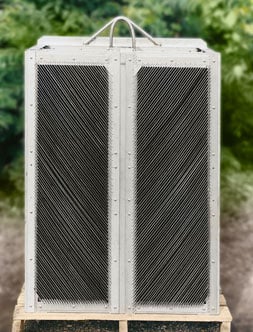
The Multi-Pack™ utilizes time-honored flat parallel plates set at a steep 55 degree angle. The smooth flat plates in a cross-flow design help make this the most non-fouling design industry has to offer. Plate gaps can be tighter with less plugging than traditional coalescer plate designs.
The smooth flat parallel plates are set at a 55° angle from the horizontal. The coalescer plates set at this steep angle help keep the solids moving downward and off the plates. This steep plate angle helps ensure that solids are processed down and out of the coalescer. [While oils and grease, in the same manner, can move upward and off the underside of the plates to be processed up and out of the coalescer.] Our smooth, flat-plate design has no “nooks and crannies” in which solids and sludge can be caught to prematurely foul the coalescer.
Other Designs: Coalescer plate angles are typically found in a range of 22° to 60° from the horizontal. One commercially available design has completely horizontal plates (highly prone to plugging) and another design has completely vertical plates (extremely inefficient for contaminant removal).
The plate widths (the dimension of the coalescer plates as measured from the inlet entry view ) never exceed 24” in the Multi-Pack design. This yields a low Equivalent Diameter, which further reduces fouling potential and is unique to the Multi-Pack design. A low Equivalent Diameter also leads to a low Reynold’s number, which describes he turbulence within the coalescer (the lower the number the more efficient the coalescer). With lesser the turbulence within the coalescer, the more oils and solids will be removed per Stoke’s Law. Mercer has the lowest Equivalent Diameter in the industry as well as the lowest Reynold’s number. Mercer’s line of separators has a standard design criteria with a Reynold’s number is between 300-350
Other Designs: Other designs have much higher Equivalent Diameters due to the longer plate widths and wider plate gaps. Further, the corrugations in the plates of other designs also increase the actual turbulence within their coalescers. Other coalescers have Reynolds numbers that may range from 500-2000.
In most of Mercer’s models (units over 30 gpm) the short plate widths have an inherent “herring-bone plate design” built into the coalescer. It is this herring-bone design that help produce the dedicated Chimney-Zone™ feature that is crucial for the removal of solids.
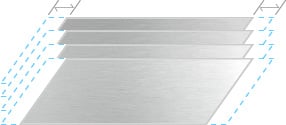
Non-fouling
The short plate width design, yields a low Equivalent Diameter (Deq). This is critical in preventing solids from building and binding up the coalescer with sludge. A low Equivalent Diameter also reduces turbulence within the separation area.
Cross Flow Design
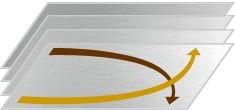
While many coalescers employ a counter-current flow of liquids and solids, Mercer utilizes a cross-flow design to combat fouling. This feature becomes increasingly important as plate gaps decrease. The Multi-Pack design allows both oil and solids to move in the direction of the flow, minimizing the counter-currents and turbulence that cause solids fouling and oil re-emulsification.

NOT ALL OIL WATER SEPARATORS ARE CREATED EQUAL.
Download our free guide to comparing coalescer designs.
.jpg)
-15.jpg)